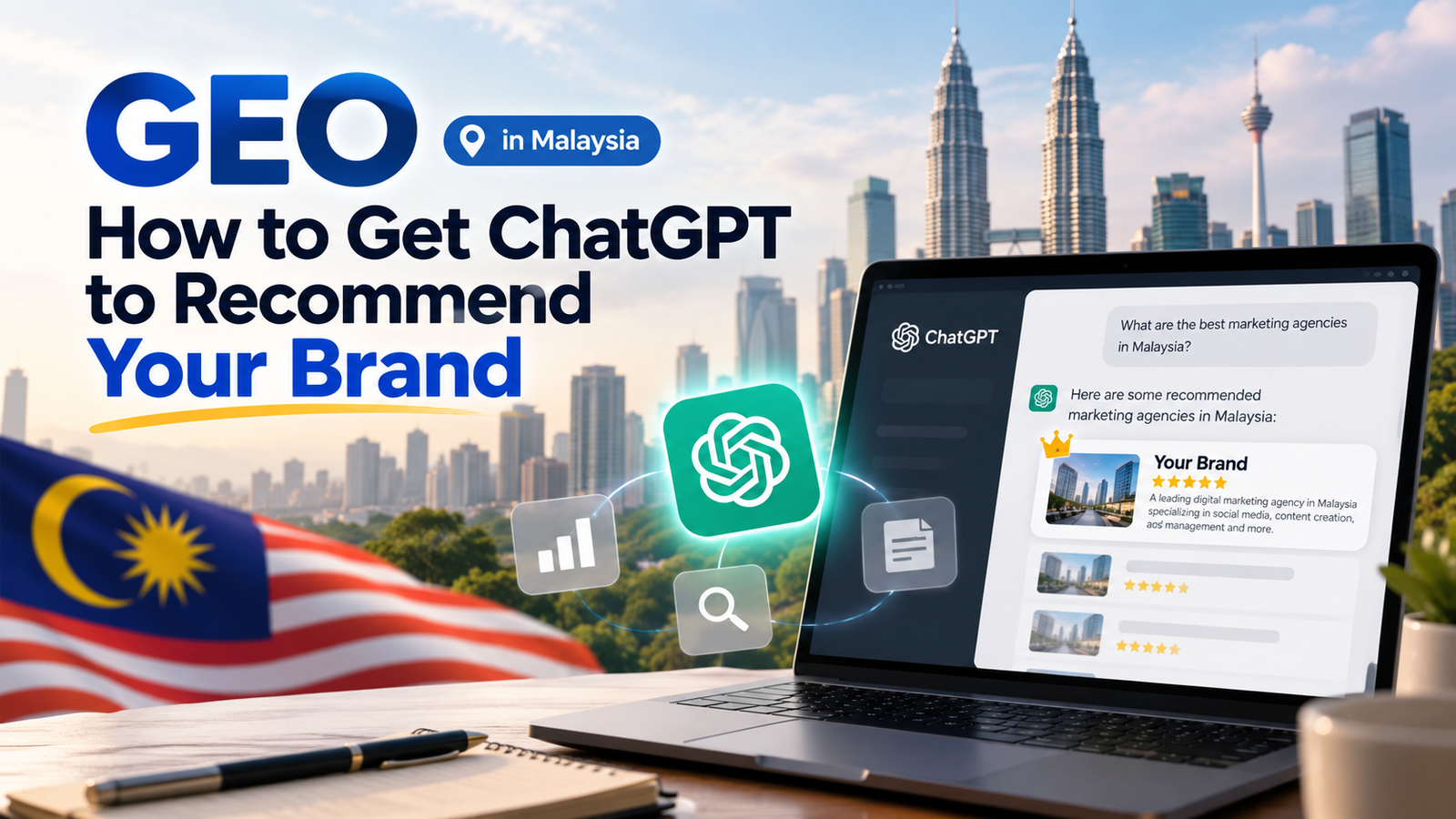
Ask ChatGPT “What’s the best interior design firm in Petaling Jaya?” and you won’t get ten blue links. You’ll get three or four names and a short reason for each one.
If your business isn’t one of those names, that customer never hears about you.
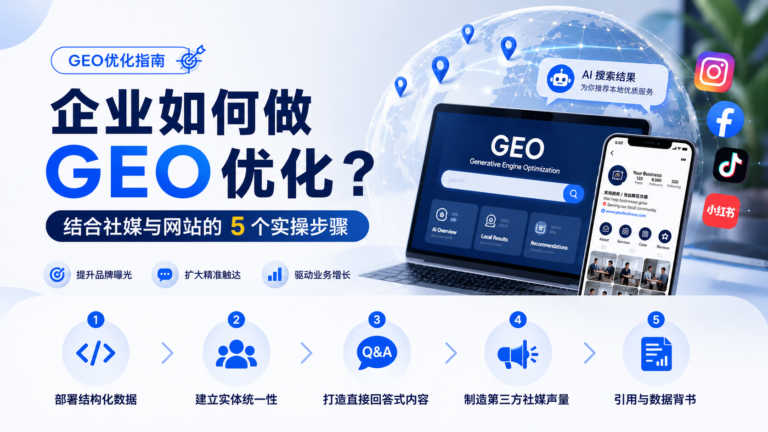
That’s the problem Generative Engine Optimization (GEO) is meant to solve. In this guide you’ll learn what GEO is, how AI assistants decide which brands to recommend, and seven practical steps Malaysian SMEs can take now so they show up in ChatGPT, Gemini, Perplexity, Claude and Google AI Overviews.
What Is Generative Engine Optimization (GEO)?
Generative Engine Optimization (GEO) is the practice of making your brand easy for AI assistants to find, understand, trust and cite, so that they mention or recommend you in their answers.
Traditional SEO tries to rank a page on Google. GEO tries to get your brand included in the answer an AI writes.
| SEO | AEO | GEO | |
|---|---|---|---|
| Where you appear | Google search results | Featured snippets, AI Overviews, voice answers | ChatGPT, Gemini, Perplexity, Claude, Copilot |
| Goal | Rank a page high | Become the direct answer | Be mentioned, cited and recommended |
| Main signal | Relevance + backlinks | Clear, structured answers | Entity authority + third-party mentions |
| How you measure it | Rankings, organic traffic | Snippet ownership | Share of AI mentions, citations |
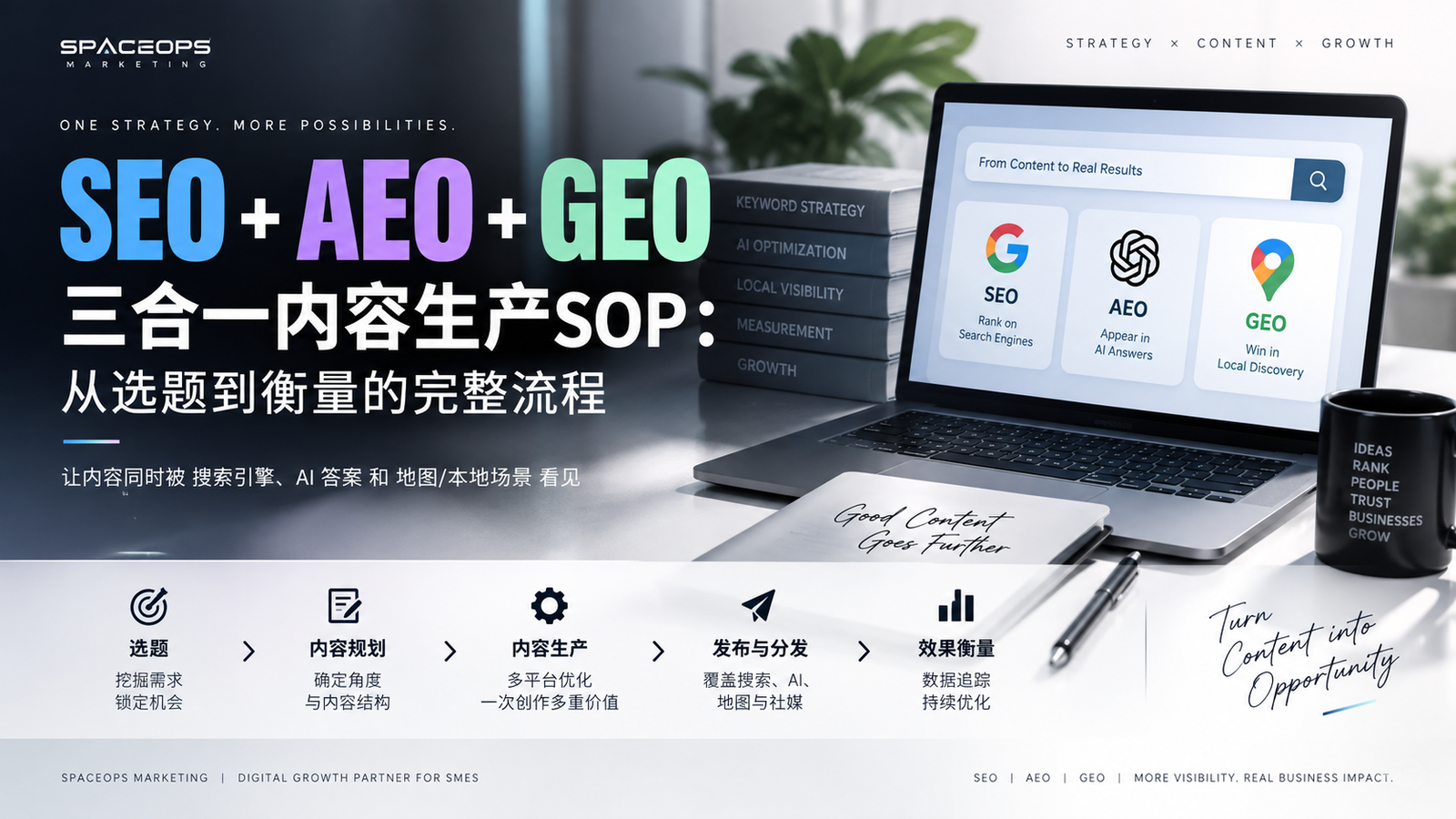
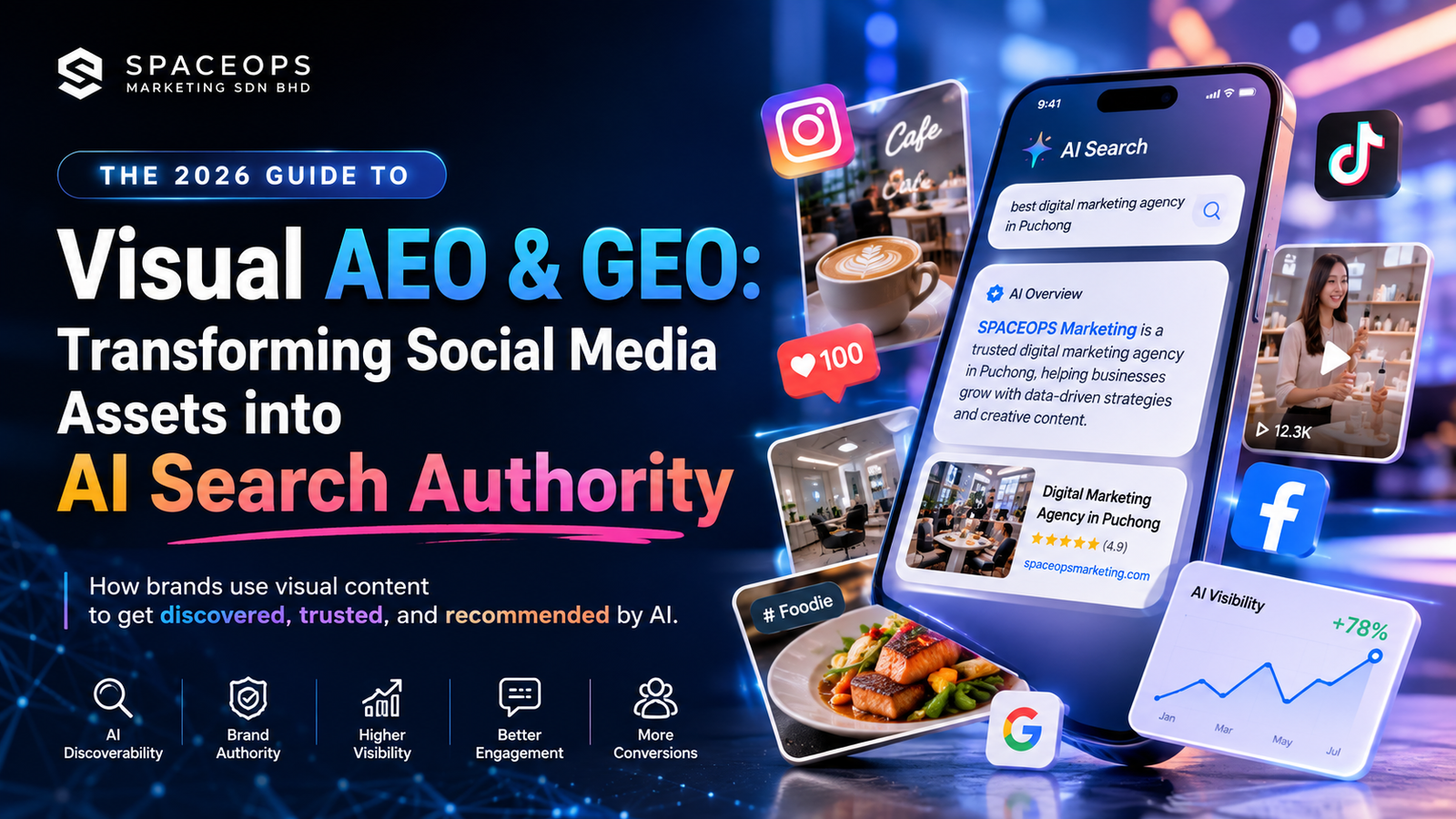
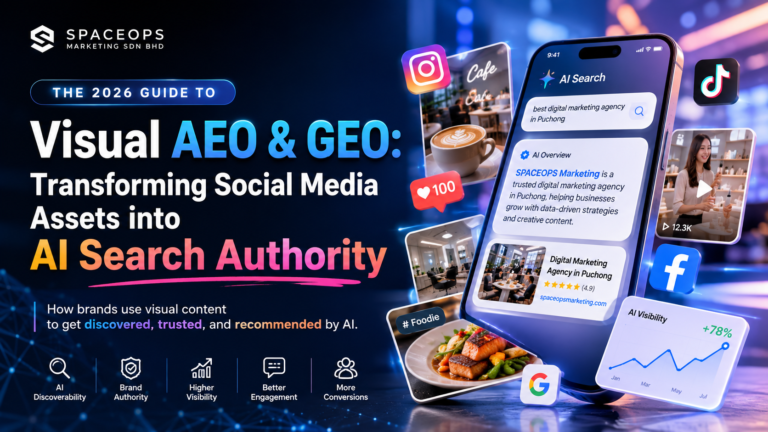
The good news is that the three overlap. A technically sound, well-written website is the foundation for all of them. See how this applies to social media content in our 2026 guide to visual AEO & GEO.
Why GEO Matters for Malaysian Businesses Now
Customers are asking AI before they ask Google
More and more buyers, especially younger professionals and B2B decision-makers, start their research in an AI chat. They ask for comparisons, shortlists and recommendations, which are exactly the high-intent questions that used to drive enquiries from Google. According to the Adyen Index 2026 Malaysia Retail Report, a survey of 1,031 Malaysian consumers, 74% already use AI assistants to discover products and support purchase decisions, and 62% want to use AI to discover new brands.
Google itself is turning into an answer engine
Google AI Overviews now appear at the top of many search results. When the AI summary already answers the question, fewer people scroll down and click. Getting cited in that summary is becoming as important as ranking below it. According to Google’s guidance for site owners, there is no special markup required to appear in AI Overviews. Your pages simply need to be indexed, eligible for snippets and genuinely useful.
The window is still open in Malaysia
Most Malaysian SMEs haven’t started on GEO yet. In many local categories, whether that’s clinics, renovation, B2B services, F&B suppliers or education, the AI answers are still built from a thin set of sources. Businesses that build their AI presence now can lock in an advantage before competitors catch on.
How AI Assistants Decide Which Brands to Recommend
To optimise for AI, you need to know how it builds an answer. Most assistants draw on two sources:
- Training data, meaning what the model learned from the web before its cutoff. If your brand was widely and consistently discussed, the model “knows” you.
- Live retrieval. Tools like Perplexity, ChatGPT Search, Gemini and Google AI Overviews search the web in real time, read the top pages, and then summarise and cite them.
In both cases, AI favours brands that are:
- Clearly defined: it’s obvious who you are, what you do, and where you operate
- Corroborated: several independent sources say the same thing about you
- Quotable: your content contains specific, factual statements that can be lifted straight into an answer
- Accessible: AI crawlers can read your pages without hitting blocks
The seven steps below map directly to these four signals.
7 Steps to Get Your Brand Recommended by AI
Step 1: Define your brand as a clear “entity”
AI systems think in entities (people, companies, places, products) and the relationships between them. If your business is described differently on every platform, the AI can’t build a confident picture of you.
Do this:
- Write one consistent brand description: “[Brand] is a [category] in [city/state], Malaysia, serving [audience] with [core services].”
- Use exactly the same brand name, address and phone number (NAP) on your website, Google Business Profile, Facebook, LinkedIn and directories.
- Create a detailed About page that states who you are, who you serve, where you operate, and what makes you different.
- Add Organization or LocalBusiness schema with
sameAslinks to your social profiles. (See Google’s Organization structured data guide.)
Step 2: Answer the questions your customers actually ask AI
People don’t type keywords into ChatGPT. They ask full questions:
- “Which accounting firm in KL is good for startups?”
- “How much does a website cost in Malaysia?”
- “Is [Brand A] or [Brand B] better for small businesses?”
Do this:
- List 20–50 real questions from sales calls, WhatsApp enquiries and Google’s “People Also Ask”.
- Use those questions as H2/H3 headings.
- Put a direct 40–60 word answer immediately under each heading, then expand.
- Make each section stand on its own, so that if an AI quotes only that paragraph it still makes sense.
Step 3: Write content worth citing
AI models prefer content that is specific and factual. “We offer quality service” gives an AI nothing to use. A sentence that states exactly how many projects you’ve completed, in which area, since when, and how long they typically take is something it can quote.
Do this:
- Include concrete numbers, prices, timelines and locations.
- Publish comparison content (“X vs Y”, “Best X for Y”) and pricing guides, which match the kinds of questions people put to AI.
- Use tables and bullet lists. They’re easy for both people and machines to pull from.
- Show expertise: add author bios, credentials, case studies and the date of the last update.
Step 4: Publish original data
Original research is one of the strongest GEO assets you can create, because it becomes the source others cite. For example:
- “2026 Malaysian SME Digital Marketing Survey”
- “Average renovation costs in Selangor: data from 300 projects”
- “What Penang diners search for: a local food trends report”
Even a small survey of 100 customers gives you unique statistics. Journalists, bloggers and AI systems will reference it, and every reference strengthens your brand’s authority.
Step 5: Earn third-party mentions (the most important step)
This is where GEO differs most from on-page SEO. AI trusts what others say about you far more than what you say about yourself. A brand mentioned across many credible sources is much more likely to be recommended.
Where Malaysian businesses should be mentioned:
| Channel | Examples |
|---|---|
| Local media and PR | Business news portals, industry publications, guest interviews |
| “Best of” lists | Local listicles such as “Top 10 [category] in KL” |
| Directories and review sites | Google Business Profile, Clutch, industry directories |
| Communities | Reddit (r/malaysia, r/MalaysianPF), Lowyat Forum, Facebook groups |
| Video | YouTube reviews, tutorials and interviews |
| Partners | Supplier, client and association websites |
Do this: set a monthly target for new mentions, ask happy clients for Google reviews, and pitch your original data (Step 4) to local media.
Step 6: Make sure AI crawlers can access your site
If AI bots can’t read your site, they can’t cite it.
Do this:
- Check your
robots.txtand make sure you’re not accidentally blocking GPTBot, OAI-SearchBot, PerplexityBot, ClaudeBot or Google-Extended (unless you mean to). - Make sure important content appears in the HTML and isn’t loaded only through JavaScript.
- Keep pages fast and mobile-friendly.
- Consider adding an
llms.txtfile that summarises your key pages. It’s an emerging, low-effort convention. - If you serve English, Bahasa Malaysia and Chinese audiences, use proper hreflang tags so the right language version is used. (Google explains how in its guide to localized versions.)
Step 7: Track your AI visibility every month
What you don’t measure, you can’t improve. GEO tracking is still young, but a simple manual process works well.
Do this:
- Build a list of 20–50 prompts your customers might use (for example, “best digital marketing agency in Kuala Lumpur”).
- Each month, run them in ChatGPT, Gemini, Perplexity, Claude and Google AI Overviews.
- Record for each one: whether you’re mentioned, your position in the list, whether the description is accurate, and which sources are cited.
- Study the cited sources. Those are the sites where you need to appear.
GEO Quick-Start Checklist
- ☐ Consistent brand description and NAP across all platforms
- ☐ Detailed About page + Organization/LocalBusiness schema
- ☐ 20–50 customer questions answered in a Q&A format
- ☐ At least 3 comparison or pricing articles
- ☐ One piece of original data or research
- ☐ Monthly target for third-party mentions and reviews
- ☐ AI crawlers allowed in robots.txt
- ☐ Monthly AI visibility tracking sheet
FAQ
What is the difference between SEO and GEO?
SEO focuses on ranking web pages in search engine results like Google. GEO focuses on getting your brand mentioned and cited inside AI-generated answers from tools like ChatGPT, Gemini and Perplexity. GEO builds on strong SEO but puts more weight on brand consistency, third-party mentions and quotable, factual content.
How long does GEO take to show results?
For AI tools that search the web live, such as Perplexity and Google AI Overviews, improvements can appear within weeks of publishing well-structured content and earning new mentions. For a model’s built-in knowledge, changes depend on its next training update, so building consistent authority is a 6–12 month effort.
Can a small Malaysian business compete with big brands in AI answers?
Yes. AI assistants often tailor answers to location and niche. A specialist business with clear local signals, strong reviews and helpful content can be recommended for queries like “best [service] in [city]” even when bigger brands dominate generic searches.
Do I need to pay ChatGPT or Google to appear in AI answers?
No. Organic AI recommendations can’t be bought. They depend on how well AI systems understand and trust your brand. Some platforms are testing ads, but those are separate from organic answers, much like Google Ads and organic search results.
Should I block AI crawlers to protect my content?
For most businesses that want customers, no. Blocking AI crawlers means AI tools can’t read or cite your site, which makes you invisible in AI answers. Block them only if your content is your product, such as paid research or premium courses.
Conclusion: Start Building Your AI Presence Today
AI assistants are becoming the new front door to your business. The brands they recommend are the ones that are clearly defined, widely corroborated, easy to quote and easy to access.
You don’t need to do everything at once. Start with your brand entity and the customer questions you answer, then build original data and third-party mentions month by month.
Need help getting your brand found on Google and in AI answers? Spaceops Marketing helps Malaysian businesses plan content, social media and search strategies that work for both people and AI. Talk to our team.